powertracjaipur@gmail.com - GST NO. : 08AASHP7571F1ZJ
- Send Email

| Business Type | Manufacturer, Exporter, Supplier, Trader |
| Click Here To View Catalog |  View View |
| Frequency | 50Hz ± 5% |
| Country of Origin | India |
| Click to view more | |
Product Details
Voltage
230V ± 20%
Current Range
5-10A, 10-40A,10A - 60A
Accuracy Class
Class 1 for kWh, Class 2 for kVARh
Max Overload
1.5 x rated current (90A for 60A)
Temperature Range
-10°C to +55°C
Humidity
95% RH max (non-condensing)
Display
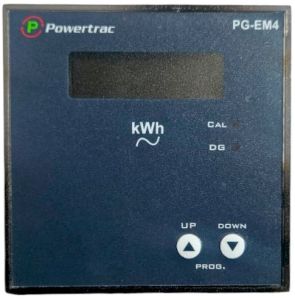
LCD digital display
Communication
RS-485, Modbus (optional)
Power Consumption
≤ 0.5W
. General Specifications:
•Standard Reference: IS 13779: 1999 (latest version) – “Static AC Energy Meters”.
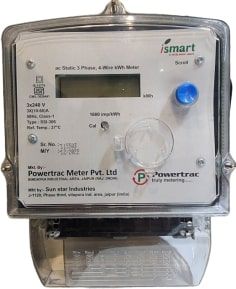
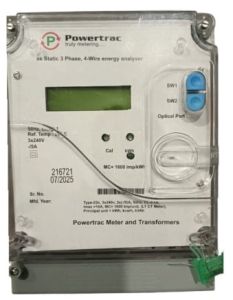
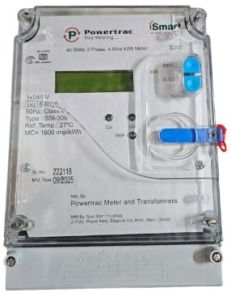
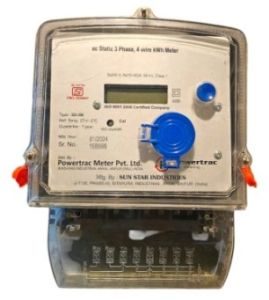
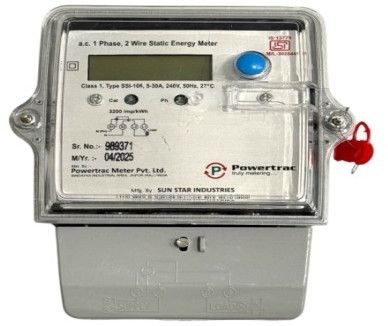
•Type: Single-phase, Multifunction Electronic Energy Meter.
•Voltage Rating: 230V AC, Single-phase, 50 Hz ± 2% (standard operating voltage).
•Current Range: 10A to 60A (direct connected).
•Frequency Range: 50 Hz ± 5% (i.e., 47.5 Hz to 52.5 Hz).
•Metering: Active energy (kWh), Reactive energy (kVARh), Apparent energy (kVAh), Power Factor, Current, Voltage, Frequency.
•Accuracy Class: Class 1 or Class 2 (depending on the model) – Accuracy tolerance of ±1% or ±2% for active energy measurement.
2. Electrical Characteristics:
•Voltage: 230V, Single-phase, 50Hz.
•Operating Voltage Range: 160V to 270V (tolerant to fluctuations).
•Overload Capacity:
oTypically, the meter can handle 1.5 times the rated current (e.g., 90A max for 60A rated meters) for a specified period, often 1 hour.
•Starting Current: ≤ 0.004A (typically, this is the minimum current the meter can measure, under which it should register energy).
•Rated Current: 10A to 60A (direct connected).
3. Accuracy:
•Active Energy (kWh): Class 1 (±1% for consumption measurement under load conditions).
•Reactive Energy (kVARh): TypicallyClass 2 (±2% for measurement of reactive energy).
•Power Factor Measurement: Typically within ±2% accuracy range.
•Current and Voltage: Accuracy for measuring current and voltage is typically ±1-2% within the rated current and voltage range.
•Frequency: Accuracy ±0.1 Hz.
4. Display and Functionality:
•Display Type: LCD (Liquid Crystal Display) for easy reading of the values.
•Display Parameters:
oEnergy (kWh, kVARh, kVAh)
oPower Factor
oCurrent (A)
oVoltage (V)
oFrequency (Hz)
oMax Demand (if supported)
oTime-of-Use (TOU) data (if supported).
•Display Readings: Clear digital display of energy consumption, power factor, and other parameters.
•Power Loss: Low power consumption of the meter for continuous operation, typically ≤ 0.5W for the meter.
5. Communication & Remote Monitoring (Optional Features):
•Communication Ports: RS-485, Modbus RTU, etc. (for remote reading and integration with Building Management Systems or SCADA).
•Data Logging: Some multifunction meters provide logging for demand, load profiles, and time-of-use data.
•Pulse Output: For external integration or data logging (optional in some models).
6. Environmental and Durability Specifications:
•Operating Temperature Range: -10°C to +55°C (for normal operation).
•Storage Temperature Range: -40°C to +70°C.
•Humidity: 95% RH max (non-condensing).
•Protection Class: IP51 (or higher), dust and splashproof, depending on the design.
•Mounting: Wall-mountable, typically with DIN rail mounting available for certain models.
7. Meter Housing and Safety:
•Material: Flame-retardant, UV-resistant plastic housing.
•Tamper Detection: Anti-tamper seals and mechanisms, including reverse-phase detection and over-voltage protection.
•Short Circuit Protection: Built-in protection against overload or short circuit in the event of wiring faults.
•Phase Reversal Detection: Some models feature phase reversal detection for additional security.
8. Compliance and Standards:
•Compliance: IS 13779: 1999 (with updates, if applicable).
•Verification & Calibration: The meters should be subject to factory calibration and verification against national or international standards (e.g., National Standards or Standards of Weights and Measures).
•Certificate: The meter is usually issued with a verification certificate that certifies its calibration and accuracy under standard conditions.
9. Other Features (Optional in Some Models):
•Time-of-Use (TOU) Metering: For varying tariffs based on consumption at different times of the day.
•Event Logging: Logging of fault conditions, power outages, and other significant events.
•Real-time Data: Some multifunction meters support real-time monitoring of power usage, offering valuable insight for energy management.
10. Installation and Operation:
•Connection Type: Direct connection (no need for external current transformers unless exceeding rated current).
•Installation Location: Suitable for indoor or outdoor installation (IP rating permitting).
•Installation Guidelines: Proper mounting per manufacturer's instructions to ensure safety and accurate readings.
Conclusion:
These GTPs ensure the single-phase multifunction energy meter provides accurate energy measurement and meets industry standards for residential and small commercial applications. Always refer to the product's specific technical datasheet for finer details, as manufacturers may include additional features beyond the base standards.
Would you like more detailed insights into how specific features work, such as time-of-use metering or communication protocols?
Looking for "Single Phase Energy Meter" ?
Piece